What “derivative at a point” means
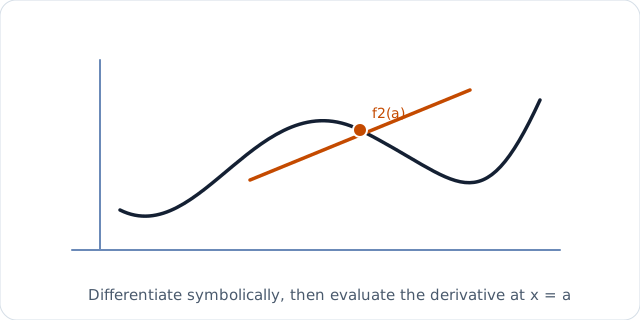
Teachers often ask for f′(a), not the full formula f′(x). That number is the slope of the tangent line at x = a. A derivative at a point calculator workflow is two steps: differentiate with free labeled rules, then plug in a carefully.
How to find f′(a) with this page
- Enter f(x) and press Calculate to obtain f′(x) with steps.
- Copy the simplified derivative into your notes.
- Substitute x = a (watch parentheses and trig values).
- Optional: write the tangent line y − f(a) = f′(a)(x − a).
This site focuses on the symbolic differentiation step — the part that needs power, product, quotient, and chain rules. Numerical evaluation stays on paper so you still practice the arithmetic your quiz may require.
Examples: differentiate, then evaluate
f(x) = x² at a = 3
f′(x) = 2x, so f′(3) = 6. Run x^2 above to confirm the power-rule step.
f(x) = sin(x) at a = π/2
f′(x) = cos(x), so f′(π/2) = 0. The calculator shows the trig derivative; you supply the special-angle value.
f(x) = (x² + 1)/(x − 1) at a = 2
Use the quotient rule in the step list, simplify f′(x), then substitute x = 2. Messy rational answers are where labeled steps save the most time.
Tangent lines and instantaneous rate
Once you have f′(a) and f(a), the tangent line is immediate. In applied problems, f′(a) is an instantaneous rate (speed, marginal cost, growth rate) at that input. For concavity at a point you may also need f′′(a) from the second derivative calculator.
Multivariable “at a point” questions often want a gradient or directional derivative instead — continue with the directional derivative calculator after you have partials.
Tips to avoid evaluation errors
Simplify f′ before plugging in. Convert degrees if your course uses them (this tool assumes the usual calculus radian trig derivatives). If a is a fraction, keep exact arithmetic until the end. For rule-focused practice before evaluating, try the product rule, quotient rule, or chain rule calculators.
Derivative at a point calculator FAQ
How does this calculator work?
It computes f′(x) with free steps. You evaluate at x = a to get the slope at the point.
Does it plug in a automatically?
Not in this version — symbolic differentiation is automatic; substitution stays manual for learning.
Is f′(a) the tangent slope?
Yes, whenever the derivative exists at that point.
Is it free?
Yes — no account and no Pro wall on steps.