How to use this free online tool
This browser-based differentiation tool is built for calculus homework. Type a function
of x (or change the variable), choose the derivative order from 1st to 5th,
and press Calculate. You get a simplified result plus a rule-by-rule
breakdown — power, product, quotient, and chain rules included.
Looking for a derivative solver, differentiation calculator, or dy/dx calculator? Same engine. Unlike Symbolab or Wolfram|Alpha Pro, step-by-step solutions stay free. No account. No upgrade prompt mid-homework.
Everything runs locally in your browser, so results appear instantly and your expressions are not sent to a remote solver for a basic first derivative. Use it before a quiz to verify practice problems, or after class to see which rule you missed when your answer does not match the key.
What a derivative calculator does
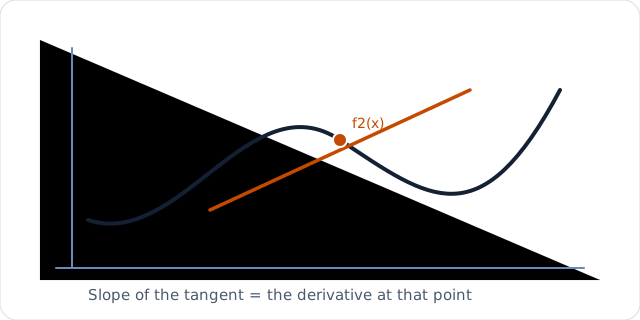
In calculus, the derivative measures how a function changes at a single point — the slope
of the tangent line. A derivative calculator applies differentiation
rules automatically so you can move from an input like x^2*sin(x) to a
simplified expression for dy/dx without rewriting every intermediate step by
hand. The value is not only the final answer: labeled steps show which rule fired, so you
can reconnect the algebra to the geometry of the curve.
Students, tutors, and engineers use an online derivative calculator for the same core
job: check work quickly, explore higher-order derivatives, and confirm that a messy
product or quotient simplified correctly. When the expression has several variables, move
to a partial workflow; for single-variable homework, stay on this page and keep the order
at 1 unless the problem asks for f''(x) or higher.
How to find the derivative of a function
To find the derivative, identify which rule applies (power, product, quotient, or chain), differentiate, then simplify. The calculator automates that workflow and shows the working so you can learn — not just copy the final answer.
- Enter the expression (use
*for multiplication and^for powers). - Confirm the variable (usually
x) and the order. - Read the labeled steps: which rule fired at each stage.
- Compare the simplified derivative with your own work.
A reliable habit is to predict the outer rule before you press Calculate. If the function
is a product, expect the product rule; if it is a composition like
sin(x^2), expect the chain rule. Matching your prediction to the step list
builds the same judgment you need on exams when no derivative solver is allowed.
When your handwritten answer differs from the tool, check three common causes: missing
parentheses around a numerator or exponent, writing 2x instead of
2*x, and forgetting to simplify after differentiating. The steps help you
see whether the mismatch is algebraic simplification or the wrong rule.
What functions this differentiation calculator supports
Polynomials and rational functions
Differentiate powers and fractions such as x^2, 3x, and
1/x with the power and quotient rules. Polynomials are usually the first
homework set after the limit definition: each term drops by one power and multiplies by
the old exponent. Rational functions add the quotient rule, so keep the denominator
squared and watch the sign on the middle term.
Examples worth practicing: 4*x^5 - 2*x^2 + 7, (x^2+1)/(x-1),
and x^(-3). Negative and fractional powers follow the same power rule once
you rewrite roots as exponents.
Trig and inverse trig
sin, cos, tan, sec, arcsin, arccos, arctan — including compositions via the chain rule.
Remember the classic pairings: the derivative of sin(x) is
cos(x), and the derivative of cos(x) is -sin(x).
For tan(x) and sec(x), the tool will surface the standard
identities so you can confirm your memory, not replace it.
Exponential and log
e^x, a^x, ln, and log10, with chain rule when the argument is itself a function. The
derivative of e^x is itself; for a^x you also multiply by
ln(a). Logarithmic differentiation shows up whenever the argument is a
product or power — try ln(x^2+1) and compare the chain-rule factor to your
own work.
Roots, absolute value, and higher-order derivatives
Roots and absolute value are supported. Raise the order to 2–5 for second (and higher) derivatives in the same workflow. Second derivatives matter for concavity and acceleration problems; third and fourth derivatives appear in Taylor polynomials and some physics models. Set the order once, calculate, and read each successive result in the step list instead of differentiating by hand five times.
Common derivative examples (homework search patterns)
Students often search “derivative of …” for specific problems. Try these in the input above — they match frequent homework queries from organic search data:
Power-rule examples
x— derivative of x is 13*x— derivative of 3x is 3x^2/x^3— power rule1/xorx^(-1)— negative powerssqrt(x)orx^(1/2)— fractional powers
Product, quotient, and chain examples
x^2*sin(x)— product + chain(x^2+1)/(x-1)— quotient rulee^(3*x)— exponential chain ruleln(x^2+1)— log + chain(x+1)/(x-1)— classic rational examplesin(x^2)— pure chain rule on a trig composition
After you get a match on these warm-ups, try mixing rules in one expression — for
example x*e^(x^2) or tan(3*x)/(x+1). The step list should show
product or quotient on the outside and chain rule on the inner function.
Common derivative rules (quick reference)
Keep this short sheet next to your notebook. The free derivative calculator applies the same identities; use the formulas below to anticipate each line of the solution.
Power rule
d/dx[xⁿ] = n·xⁿ⁻¹. Constants pull out: d/dx[c·f] = c·f′. Sums differentiate term by term, which is why polynomials feel mechanical once the rule clicks.
Product rule
(fg)′ = f′g + fg′. Write both factors, differentiate one at a time, and add. A common slip is forgetting the second term when one factor “looks simple.”
Quotient rule
(f/g)′ = (f′g − fg′) / g². Numerator is “derivative of top times bottom, minus top times derivative of bottom”; denominator is bottom squared. Sign errors here are the usual reason a rational answer disagrees with the calculator.
Chain rule
(f(g(x)))′ = f′(g(x))·g′(x). Differentiate the outer function, leave the inside alone, then multiply by the inside derivative. Compositions of trig, exp, and logs almost always need this step.
Sum and difference
Differentiate term by term. Combined with the power rule, this covers most early polynomial homework before products and quotients appear.
Need the working spelled out for every rule? Open the derivative calculator with steps landing page — same free engine, steps-first framing.
Tips for accurate input and faster checking
Small syntax habits prevent most “wrong answer” moments. Always type multiplication with
*, write powers with ^, and wrap numerators, denominators, and
exponents in parentheses when they contain more than one token. Prefer
(x+1)/(x-1) over ambiguous spacing, and e^(3*x) over unclear
stacked notation.
Start with order 1 unless the problem asks for a second derivative or higher. If you are checking an applied problem (velocity from position, marginal cost, growth rate), differentiate once symbolically here, then plug in the number on paper so you still practice evaluation. When several letters appear and only one is the independent variable, set that variable explicitly so the differentiation calculator does not treat the wrong symbol as the input.
Online tool vs paid solvers
Broad platforms often gate detailed steps behind a subscription. This site is a focused free differentiation / differential calculator for calculus homework: fast load, steps visible by default, and no login. Use it as a derivative finder to check answers, then study the labeled rules so you can reproduce them on paper.
Paid suites can be useful for huge CAS workloads, integrals, and equation solving in one place. For the narrower goal of finding derivatives with transparent steps, a dedicated free tool is usually enough — and it avoids interrupting study flow with upgrade modals. If your course bans CAS on exams, treat this page as a coach: attempt the problem first, then compare rules, not as a substitute for learning the identities.
Working with several variables? Switch to the partial derivative calculator to compute ∂f/∂x or ∂f/∂y while treating other letters as constants.
Derivative calculator FAQ
Is this derivative calculator free?
Yes. Computation and step-by-step explanations are free. No account required — built for students who need answers and the rules behind them. There is no Pro tier that unlocks the working; steps stay available on every calculation.
How do I find the derivative of a function with this tool?
Type the function, set the variable and order, then press Calculate. The differentiation calculator returns the simplified result and labels each rule so you can follow the same sequence on paper.
Can I compute second derivatives?
Yes — set Order to 2 (or higher, up to 5). Each order is shown in the step list, so this also works as a second derivative calculator for concavity or acceleration checks without re-entering the function.
Do you support partial derivatives?
Yes. Use the partial derivative calculator and choose the variable (x, y, …). Other letters are treated as constants for that computation.
Is a derivative solver the same as a differentiation calculator?
Yes. People also search for derivative calc, calculator for derivatives, differential calculator, and dy/dx calculator — they all mean finding derivatives online with optional step-by-step help. The wording changes; the calculus task is the same.
How is this different from Symbolab?
We focus on derivatives, keep steps free, and load fast. Symbolab is a broad solver suite that often gates detailed steps behind a subscription. If you only need differentiation with clear rules, this lighter page is usually quicker to open and easier to stay on task with.